

A Simple Exercise to Start Understanding What You Actually Want
One of the most common things people say, often with a mix of frustration and uncertainty, is:
“I just don’t know what I want.”
On the surface, it sounds like a simple problem. But in reality, it rarely is.
Because most of the time, it’s not that you have no desires, direction, or preferences at all. It’s that your thinking has become crowded. Over time, layers begin to build: expectations, responsibilities, past decisions, other people’s opinions, and the version of life you thought you should be building.
Somewhere within all of that, your own voice becomes harder to hear.
So when you try to answer the question directly — What do I really want? — your mind either goes blank, or offers answers that feel uncertain, forced, or slightly disconnected from what’s actually true for you.
This is why trying to “figure it out” through pure logic often doesn’t work.
Clarity tends to emerge more naturally when you approach it from a different angle, one that gives you space, rather than pressure.
A Different Way In
Instead of asking yourself for a final answer, it can be far more useful to explore something softer, but more revealing:
Who are you becoming?
Not in an idealised, unrealistic sense. Not the version of you shaped by external expectations. But a version of you that feels more aligned, more settled, and more like yourself.
This exercise is designed to help you access that perspective.
It doesn’t require certainty. It simply requires a willingness to pause, reflect, and notice what emerges.
The Future Self Exercise
Set aside a few quiet minutes for this. No distractions, no urgency.
Start by choosing a point in the future that feels meaningful, but still believable. This could be six months from now, a year, or a few years ahead. There’s no right choice, just pick something that feels engaging enough to hold your attention.
Then, picture a version of yourself at that point in time.
Not a perfect version. Not a version that impresses other people. Just one that feels more aligned.
From there, gently explore the following:
What kind of person are you in that future?
What feels important to you now that perhaps didn’t before?
How do you carry yourself day to day?
What behaviours or habits feel natural to you?
What have you stopped tolerating?
What feels easier than it does right now?
There’s no need to overthink your answers. In fact, the more you try to get them “right,” the less helpful they tend to be. Let your responses come naturally, even if they feel slightly unclear or incomplete.
You’re not trying to define your entire future. You’re simply observing what your mind is drawn towards when given the space to explore.
Why This Works
When you approach things this way, something subtle but important happens.
You create just enough distance from your current situation to step out of your usual thinking patterns. You’re no longer trying to solve everything from within the same mindset that feels stuck.
Instead, you allow a different perspective to emerge.
From that place, it becomes easier to notice:
What feels aligned
What feels out of place
What you may have been overlooking
For many people, the surprising part is not that they suddenly have all the answers, but that things feel clearer than they expected.
Not because anything external has changed, but because they’ve finally given themselves the space to hear their own thinking properly.
Bringing It Back to the Present
Once you’ve explored your future self, resist the urge to turn it into immediate action.
You don’t need to make a big decision or create a plan straight away.
Instead, stay with the awareness you’ve just created.
You might reflect on:
What feels different between where you are now and the version of you you’ve described
What stood out most during the exercise
What felt unexpectedly important or revealing
Even small observations here can be powerful.
Because clarity rarely arrives as one big, definitive answer. More often, it shows up in quieter ways, a shift in perspective, a subtle realisation, a growing sense of what feels right and what doesn’t.
And those small shifts are often what lead to meaningful change over time.
If You Want to Go Deeper
This is a simplified version of a tool I use within my coaching work.
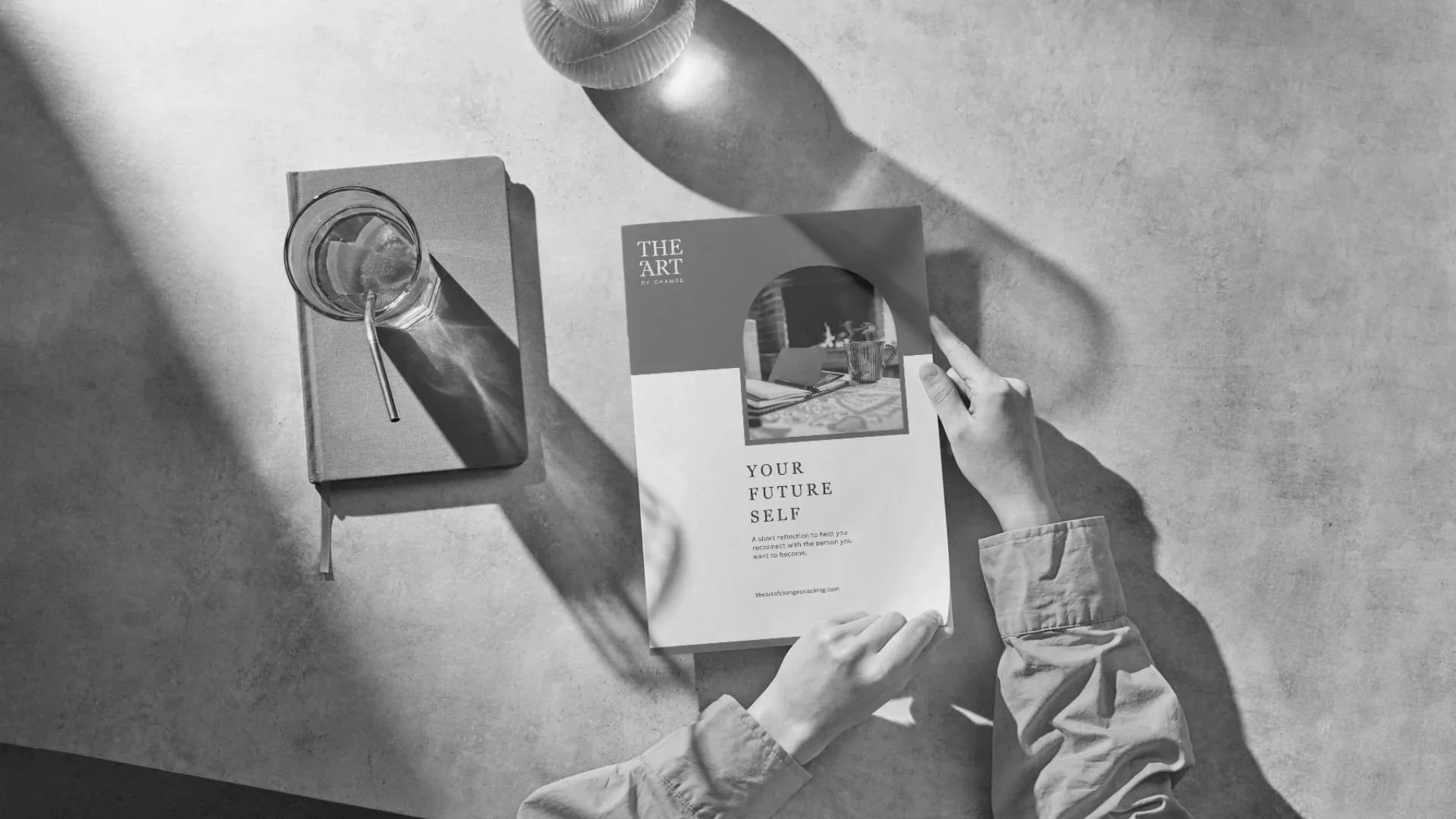
If you found this helpful, you can download the full Future Self exercise on the website homepage. It expands on this process in more depth, guiding you through your values, behaviours, and a reflective practice designed to help anchor these insights into your day-to-day life.